
As a refractory metals supplier focused on specialty and low-volume applications, we recently completed a small-batch order of 0.8mm pure niobium wire for a client in Canada, finalized just ahead of China’s National Day holiday. We’re using this exact batch to break down our end-to-end quality control process, because we believe transparency around material verification is critical — especially for an industry where surface appearance tells you almost nothing about actual purity and in-service performance.
In over a decade working with niobium and other high-purity refractory metals, I’ve seen far too many suppliers cut corners on quality for small orders. Many will ship spools with only a generic spec sheet, no batch-specific testing, and no traceability back to the original ingot. For us, every order gets the exact same level of scrutiny, whether it’s a single half-kilogram spool for R&D testing or a 50kg production run.
Why Niobium Wire Quality Starts With Raw Ingot Verification
Niobium wire performance is locked in long before the material ever enters a drawing die. The purity and interstitial element profile of the starting ingot sets the absolute ceiling for what the finished wire can achieve.
We never rely solely on mill-provided ingot specs. Before production begins on every batch, we sample the raw niobium ingot and send it to an independent third-party laboratory for composition analysis. For this UNS R04200 batch, we tested core metallic impurities — molybdenum, tantalum, tungsten, and zirconium — and all results fell well within ASTM B392 acceptable ranges.
This step catches off-spec or recycled feedstock before it goes into production. Recycled niobium may look identical on the surface, but inconsistent impurity levels lead to premature failure in high-temperature applications, degraded corrosion resistance, and unstable arc performance in atomization electrode setups. It’s a risk we will not take, regardless of order size.
Why Raw Ingot Tests Aren’t Enough: Mill Test Certificates for Finished Wire
A common misconception in this space is that an ingot test report equals a finished product guarantee. That is never the case.
After multi-pass drawing, stress-relieved annealing, and final finishing, interstitial elements (carbon, oxygen, nitrogen, hydrogen) can shift, and dimensional tolerances can vary across the length of the spool. That’s why every finished batch ships with an official, batch-specific Mill Test Certificate (MTC) that verifies the as-delivered properties of the wire itself.
For this 0.8mm niobium wire batch:
- Total niobium + tantalum content: 99.96%
- Full interstitial and metallic impurity breakdown, all compliant with ASTM B392 UNS R04200
- Verified diameter: 0.8mm, with consistent dimensional tolerance across the full length
The MTC is your guarantee that what you receive matches the specs you ordered — not just what went into the factory.
Our 3-Step Final Inspection Before Every Shipment
Before any spool leaves our facility, we perform a hands-on final inspection on every order, no exceptions:
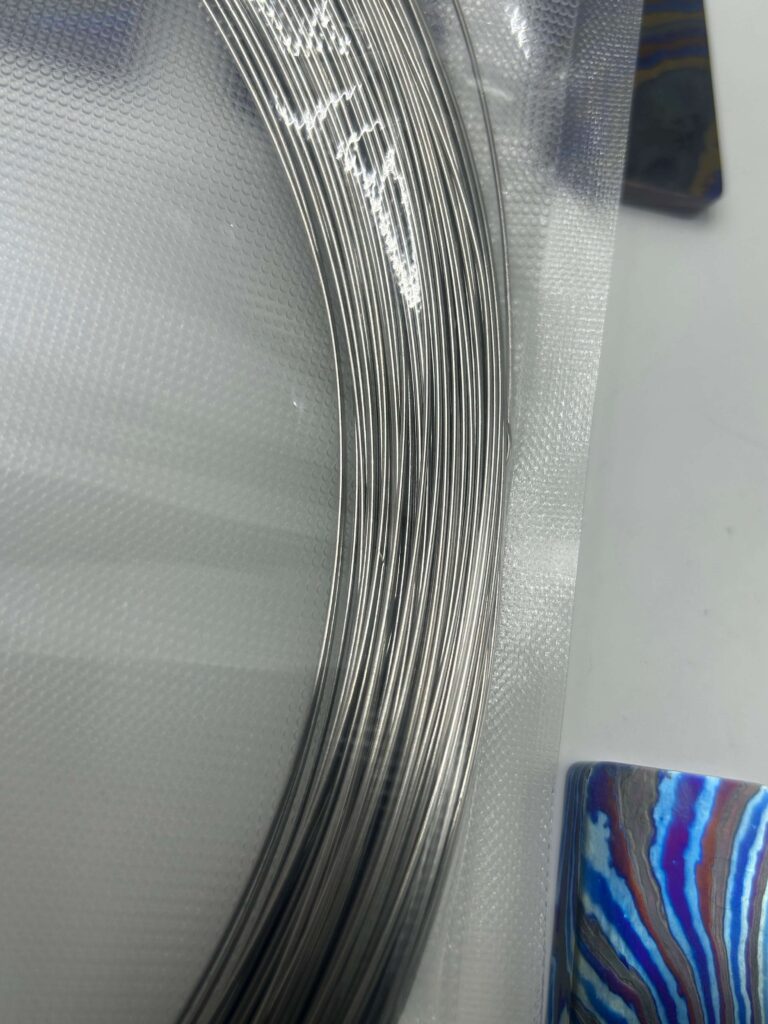
- Surface Quality Check We inspect the full length of the wire for scratches, burrs, die marks, and oxidation discoloration. For 0.8mm wire — a size most commonly used for atomization nozzles, custom electrodes, and precision fabrication — surface finish directly impacts flow consistency, arc stability, and end-part performance.
- Dimensional Uniformity Verification We spot-check diameter at multiple points along the spool to ensure consistency. Drawing variations can cause thin spots that lead to unexpected breakage in use; our in-process tolerance control eliminates this variable.
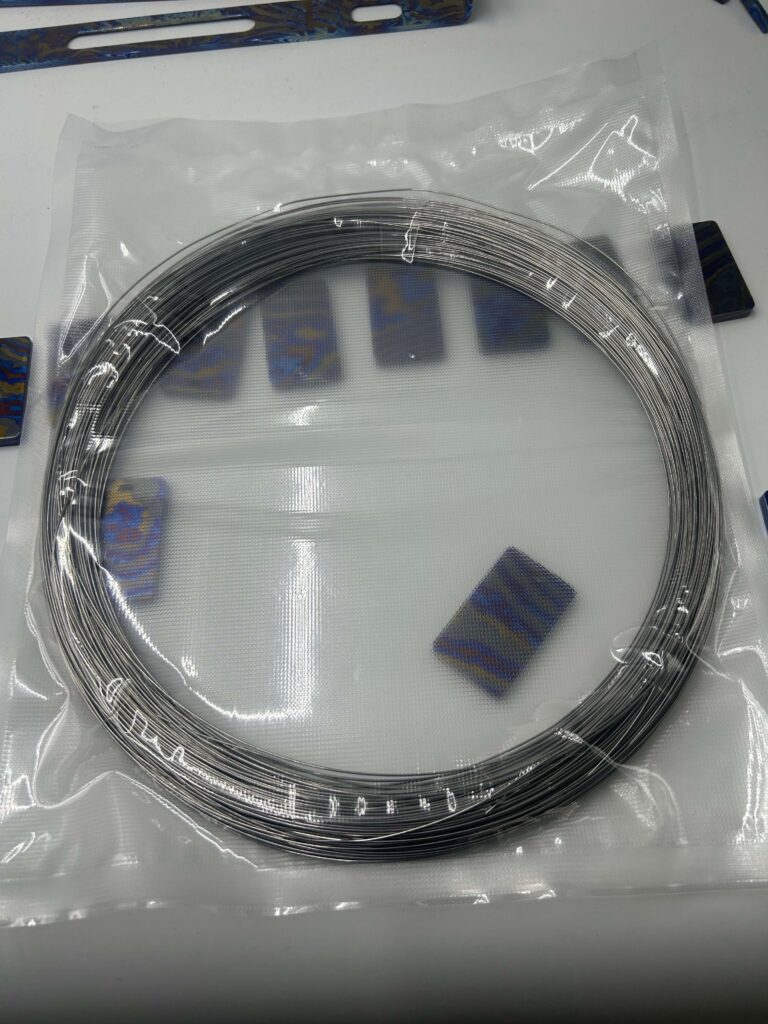
- Vacuum Sealing for Transit Protection Every spool is vacuum sealed immediately after inspection. Niobium is reactive to moisture and atmospheric contaminants over long international transit. Vacuum packaging prevents surface oxidation and contamination, so the material arrives in the exact same condition it left our facility.
No Order Too Small: The Same QC Standard For Every Batch
Niobium is a niche material, and most of our North American customers are researchers, custom fabricators, and specialty engineering teams. Many only need small quantities for proof-of-concept testing, prototype builds, or one-off projects.
We don’t enforce arbitrary high minimum order quantities, and we never downgrade our quality process for small orders. You get the same third-party ingot verification, batch-specific MTC, and final inspection whether you order one spool or one hundred.
Common Applications For 0.8mm UNS R04200 Niobium Wire
This diameter and grade is widely used across the U.S. and Canada for:
- Plasma atomization electrode wire
- Custom anodizing and electrolysis setups
- High-temperature furnace heating elements
- Precision jewelry and metal art craft
- R&D materials testing and alloy development
Closing Thoughts
Quality in refractory metals isn’t about flashy marketing or bold purity claims. It’s about consistent, documented verification at every step of production.
Export permits for this batch will be processed the first business day after the holiday break, and the order will ship via DHL immediately after clearance.
If you’re sourcing niobium wire for a specific application, or you’re unsure which grade or diameter matches your requirements, reach out directly. We provide straightforward, application-specific recommendations — no upselling, no over-spec’ing, just material that works.